
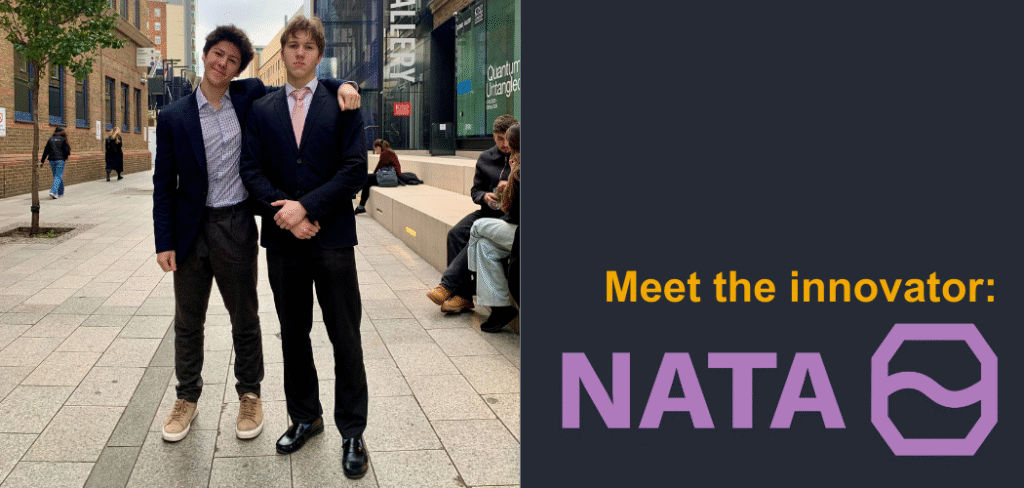
Alexey Medvedev and Vitaly Soldatenko, developers of the Non-Invasive Alzheimer’s Treatment App (NATA), share why accessible digital dementia support matters, and how ICHP’s guidance has been crucial in accelerating their innovation.
Imagine if preventing Alzheimer’s or reducing its symptoms could be as simple as listening to your favourite music or podcasts. This question inspired us to begin building a free, non-invasive digital tool to support people living with Alzheimer’s disease and other forms of dementia.
We are Alexey and Vitaly, the co-developers of the Non-Invasive Alzheimer’s Treatment App (NATA) – an early-stage online platform that uses scientifically validated audio-visual stimulation techniques to help reduce symptoms of dementia. As two high school students passionate about neuroscience and digital innovation, we wanted to create a simple, accessible tool that anyone could use, anywhere in the world.
Through the support of Imperial College Health Partners (ICHP), we have been able to accelerate the early development of our idea, receive expert feedback, and begin exploring the pathways needed to bring digital innovation safely and effectively into real clinical care.
Why we started NATA: Improving early intervention and accessible dementia support
Globally, around 55 million people live with dementia, with numbers expected to almost triple by 2050 (reference). In the UK, 61% of adults worry about dementia affecting them or someone close to them (reference). Yet access to specialist dementia therapies can be limited, especially in low- and middle-income countries, and long waiting times often make early intervention difficult.
After learning about emerging MIT research on audio-visual gamma stimulation, we realised there was an opportunity to translate this science into an online tool that anyone could use at home. Despite promising results from clinical studies, this technique hadn’t yet been implemented in a simple, user-friendly digital format.
With NATA, we aim to address barriers such as:
- Limited access to specialist dementia therapies
- Financial barriers, particularly in countries with fewer healthcare resources
- Long waiting times for dementia support
- A lack of practical tools that embed research into everyday life
By keeping NATA simple and accessible, we hope that individuals, carers, and clinicians can incorporate it easily into routine dementia care.
How ICHP Supported Us
At the early stage of building NATA, we reached out to ICHP for guidance. Their response, and ongoing support, has been instrumental in helping us understand what is needed for digital health innovations to progress safely and effectively within the NHS.
ICHP invited us to a 60-minute Innovation Surgery, with Innovation Manager Lucie Wellington, where we discussed opportunities to strengthen both the technical development of the app and the way we present its purpose and value. From that session, we received:
- Guidance on NHS expectations, standards, and evidence requirements for digital tools
- A connection to UCLPartners, who run a large-scale dementia research programme
- An invitation to the Brain Health Innovation Event at King’s College London, through an introduction to the Brain Health Healthtech Research Centre, where we met clinicians, researchers, and innovation leads
- Introductions to key experts, including an NHS licensing expert, who showed interest in the potential of NATA in clinical pathways
Thanks to these connections, we also arranged a meeting with a Research Portfolio Lead at the Institute of Psychiatry, Psychology & Neuroscience at King’s College London, to explore potential future clinical trials.
Alongside feedback from the MIT professor of Computer Science and Computational Biology, the scientific guidance and strategic support from ICHP have helped us shape the direction of the project, understand the landscape of dementia innovation, and uncover important next steps for evaluation and scale-up.
For us, working with ICHP has opened doors to expert networks, practical advice, and a deeper understanding of how digital health technologies can be meaningfully integrated into clinical care.
Are You an Innovator Ready to Work with ICHP?
To access advice and guidance, please submit our Innovation Engagement form here.
Interested in NATA?
You can find out more about our innovation at the NATA website: https://nata.website/
Or get in touch with the founders here: Alexey Medvedev (aleksei.al.medvedev@gmail.com) and Vitaly Soldatenko (vitalijs.soldatenko@gmail.com)