
London North West University Healthcare NHS Trust (LNWUH) has taken a proactive, culture-driven approach to piloting Martha’s Rule across its three hospital sites – Phase 1 pilot sites Northwick Park Hospital and Ealing Hospital, and Phase 2 pilot site Central Middlesex Hospital. This case study highlights the trust’s piloting journey, strategies for improving staff engagement, key enablers, and lessons learned, focusing on visible leadership, safety culture, staff training, and continuous improvement.
From the beginning, LNWUH’s leadership has positioned Martha’s Rule as a critical enabler to improve patient safety, by embedding the patient and carer voice into care as a cultural norm.
Pilot journey
The trust launched Call 4 Concern (C4C) in May 2024 at Northwick Park and Ealing Hospitals, and soon after expanded to Paediatrics in March 2025, and introduced the initiative in Maternity and Neonatal services in August 2025. In November 2025, C4C was successfully launched at Central Middlesex Hospital, achieving trust-wide coverage. Alongside C4C, LNWUH trialled Patient Wellness Questionnaires (PWQs) on three wards at Northwick Park and Ealing Hospitals, followed by a second trial using the ISLA platform to support digital recording and analysis.
Imperial College Health Partners (ICHP), as the local Patient Safety Collaborative, is playing a pivotal role in supporting LNWUH’s Martha’s Rule journey. ICHP provides quality improvement expertise, helping the trust apply PDSA cycles and data-driven approaches to refine implementation. It facilitates shared learning across North West London (NWL), London and nationally and has established a NWL Martha’s Rule community of practice, ensuring LNWUH benefits from best practice and insights from other pilot sites. ICHP also delivers culture change interventions, such as MOMENTS training, to strengthen psychological safety and encourage speaking up. In addition, ICHP supports programme governance and reporting, connecting LNWUH with NHSE and regional partners to accelerate adoption and sustain impact. This partnership ensures Martha’s Rule is embedded as part of a system-wide effort to improve patient safety.
Driving culture change to embed Martha’s Rule
While Martha’s Rule piloting now spans all LNWUH sites – including adult, paediatric, maternity and neonatal settings – sustaining momentum toward further scaling and embedding the principles into everyday practice remains a priority. Culture change is being driven through three key approaches:
- Roadshows: Building engagement through curiosity and education
Critical Care Outreach Team (CCOT) and wider staff engagement are essential for effective and meaningful piloting of Martha’s Rule. Despite enhanced C4C availability, calls to CCOT reduced, and no maternity calls were recorded in the first two months post roll-out. With trust-wide PWQ implementation on the horizon, socialising Martha’s Rule and reinforcing its purpose is a priority.
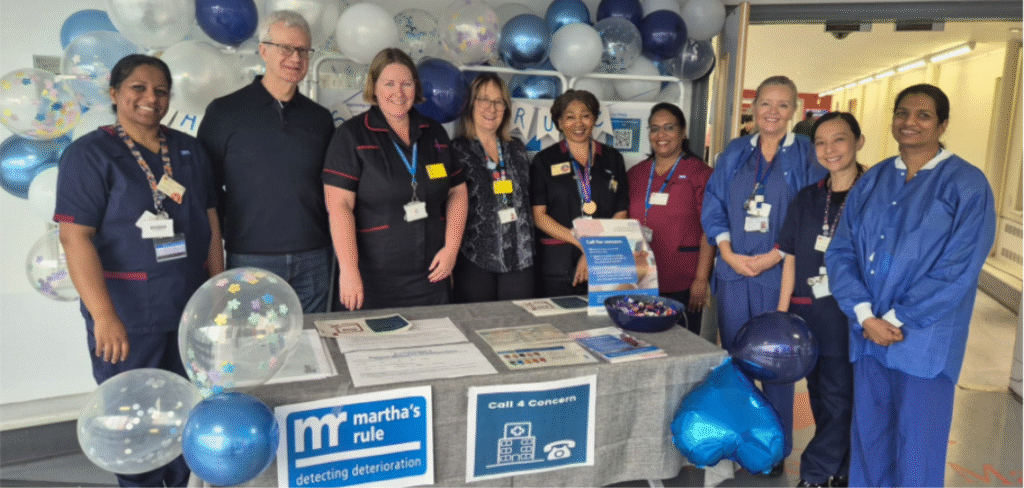
To address this, the trust’s dedicated Martha’s Rule team introduced interactive Roadshows in high-traffic areas, such as near the main canteen at Northwick Park. These events attracted over 150 staff, patients and relatives, using quizzes and posters as a prompt for valuable discussions. The Roadshow approach sparked curiosity, built confidence in using C4C and the Patient Wellness Questionnaire, reinforced psychological safety and encouraged staff confidence in speaking up.
Key insights
The Roadshows also served as a listening exercise and captured valuable insights, revealing gaps in awareness and informing future PDSA cycles. Insights included the need for more consistent poster distribution, reframing C4C as an integrated safety layer rather than an “extra” initiative, and ensuring materials are inclusive and accessible for all service users. These findings shaped subsequent engagement strategies and training.
Wider training and support
Complementary initiatives included comprehensive, ongoing CCOT and ward staff training and development of tailored educational materials (i.e. posters, screensavers). Hands-on facilitation during PWQ trials and ISLA testing, clear Standard Operating Procedures (SOP), and regular communication channels reinforced this approach.
LNWUH has also employed a train-the-trainer model to build champions across the organisation, upskilling others to enable scaling of the initiative at pace across the trust.
- Iterative, test and learn approach
LNWUH adopted a continuous improvement mindset, embedding feedback loops throughout piloting to ensure Martha’s Rule evolved in response to real-world challenges. Rather than implementing a static model, the trust embraced phased rollout and small tests of change, starting with adult wards before expanding to paediatrics, maternity, and neonatal services. Each phase was treated as an opportunity to learn, adapt, and refine processes.
The PWQ trials exemplify this approach. Initial testing on three wards provided insights into workflow integration and staff usability, which informed adjustments before scaling. The second trial introduced the ISLA platform for digital data capture, enabling real-time monitoring and analysis. This iterative process allowed the team to identify barriers early, such as technical challenges and staff confidence, and address them through targeted training and SOP revisions. By applying PDSA cycles and embracing a fail fast, learn quickly philosophy, LNWUH ensured that Martha’s Rule implementation remains agile, responsive, and grounded in frontline feedback.
Data
Early data from 2025 show that LNWUH received over 250 Martha’s Rule calls, providing a rich source of insight to guide ongoing refinement. While the majority of calls were non‑clinical (74%), around a quarter were clinical (25.19%), with deterioration-related escalations increasing over time – an indication that communication and education efforts are improving awareness and confidence in the system. Notably, 18.75% of clinical calls were identified as true clinical deterioration, triggering timely interventions that prevented further decline.
Equality data gathered through the pilot also show that the demographic profile of callers closely mirrors the trust’s diverse population, with escalations coming from patients across a range of ethnic backgrounds and deprivation deciles. This confirms that Martha’s Rule is being accessed by a varied group of service users, reinforcing that a one‑size‑fits‑all approach is not sufficient and that equity must remain central. Together, these data have played a central role in informing iterative improvements, shaping training, and validating the trust’s phased, test‑and‑learn approach.
- Building champions through strong, visible leadership
Leadership has been the cornerstone of LNWUH’s success. From the outset, senior leaders actively championed Martha’s Rule, modelling visibility and accessibility. The Head of Nursing for Critical Care Services, who leads the initiative, maintains a strong presence on wards, fostering trust and psychological safety through open-door policy and proactive engagement with teams. This visible leadership signalled organisational commitment and encouraged staff to embrace the cultural shift.
“I have engaged my teams and listened to their challenges, especially in relation to workload and complex service users, and worked collaboratively to produce pathways across services including Maternity and Paediatrics. Lead from the back as required and give ownership to teams to design pathways that are practical, pragmatic and aligned with Martha’s Rule guidance. A leader should know the subject matter, support access to training, and empower teams to shape solutions.”
– Isatu Kargbo, Head of Nursing Critical Care Services, LNWUH
Structured governance reinforced this leadership approach and has helped to embed Martha’s Rule as a key priority for the trust. A dedicated Martha’s Rule task and finish group, meeting every 2-4 weeks, brought together CCOT leaders, divisional representatives, patient experience leads, and a patient representative to co-design solutions. Senior leaders presented progress at divisional governance forums, clinical operations huddles, and nursing boards, securing buy-in across all levels. Champions were identified within wards and specialties, supported through training and regular communication. Collaboration extended beyond the trust, with active engagement of NHSE, regional partners, and ICHP to share learning and accelerate adoption. This combination of top-down commitment and bottom-up empowerment created a strong foundation for cultural change.
Lessons Learned
- Visibility matters: Leadership presence and proactive engagement like the Roadshows build trust and curiosity.
- Iterate continuously: Feedback loops and PDSA cycles are essential for enabling a fail fast, learn quickly culture and sustaining momentum.
- Culture change takes time: Embedding psychological safety and encouraging speaking up requires persistent effort.
- Co-creation with staff: Engagement drives ownership and adoption.
- Digital tools can accelerate progress: Platforms like ISLA enable data-driven improvement and storytelling to motivate change.
- Data sharing drives collective improvement: Regularly sharing both qualitative insights and quantitative data has strengthened trust‑wide and system‑wide buy‑in, enabling teams to understand patterns, discuss challenges openly and refine practice more effectively. Engagement through the wider Acute Provider Collaborative forums and the ICHP‑led Patient Safety Collaborative for North West London has been instrumental in accelerating learning and supporting the spread and scale of effective approaches across the region.
- Trust-wide engagement is critical: Ownership, from CCOT teams and ward teams alike, underpins impactful use of Martha’s Rule and a culture that empowers staff and places the patient and carer voice at the heart of their care.
Next steps
- Extend roadshows to Ealing and Central Middlesex sites.
- Embed Martha’s Rule information in patient experience leaflets, including multilingual versions.
- Dedicated efforts to overcome communication barriers and advance equity in access by working with the trust Dementia Matron, Communication team and other Heads of Nursing to adapt Martha’s Rule resources for vulnerable groups of patients.
- Scale PWQ implementation trust-wide using ISLA.
- Continue collaboration with ICHP and share learning nationally.
LNWUH is embedding Martha’s Rule as a cultural norm – moving beyond a single intervention to a fundamental shift in how care is delivered. Through leadership, innovation and engagement, the Trust is creating safer environments where patients, families and carers are empowered to raise concerns about their health condition.