
Patient safety is a key NHS priority. Sustaining and scaling safety improvement practices requires consistency, a shared patient safety lens, and the connective tissue to turn isolated good practice into system-wide improvement. This is the work ICHP has been leading through the North West London (NWL) Patient Safety Collaborative (PSC) for nearly a decade.
What the Patient Safety Collaborative actually does
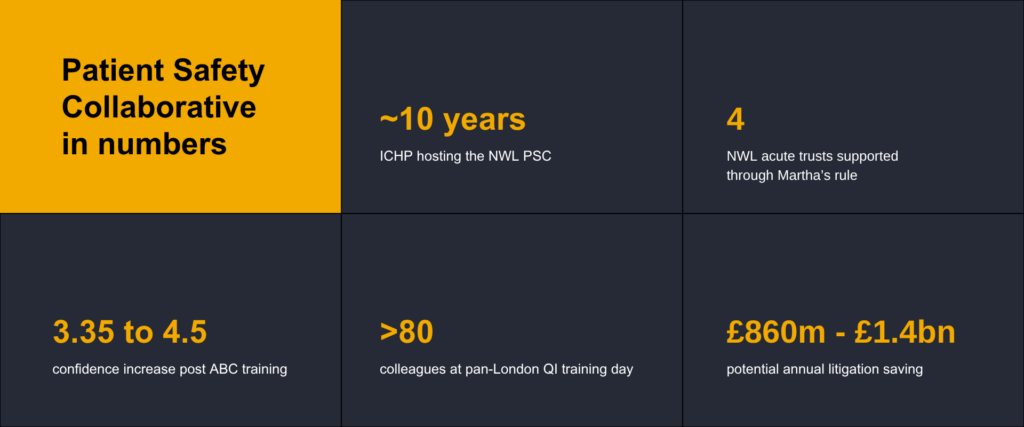
ICHP has hosted the NWL Patient Safety Collaborative (PSC) for approximately 10 years, commissioned by NHS England and anchored in the National NHS Patient Safety Strategy. That tenure matters: patient safety culture is not built quickly, and the relationships, trust and shared language that make improvement possible across complex systems take sustained investment to develop.
Shakti Dookeran, who leads the PSC at ICHP, is clear about the nature of the role. The PSC convenes the system to augment and scale good practice, providing a suite of support to overcome key challenges. Its role is to drive higher quality, greater consistency and a shared patient safety culture across priority projects system-wide. Discovery The PSC’s offer is organised around four areas of activity, each of which supports a different part of the system’s journey toward safer, more consistent care.
“The PSC plays a vital role in driving systemwide collaboration, consistency and learning – strengthening patient safety through a focus on quality improvement and culture.”
Shakti Dookeran, Innovation Lead, NWL Patient Safety Collaborative
Running through all four areas is a shared aspiration: to make patient safety everyone’s business. Not the responsibility of a specialist team or a commissioned programme, but a live, embedded part of how every clinical team thinks and works
| Discovery | Identifying the local landscape – the challenges, the stakeholders, the common barriers. Understanding where the PSC can make its biggest impact before any intervention is designed. |
| Implementation support | Building quality improvement (QI) capability, safety culture Implementation support Communities of practice and leadership across the system. This is where the work of culture change actually happens: coaching teams, developing communities of practice, helping multidisciplinary teams (MDTs) get comfortable with quality improvement approaches and data. |
| Communities of practice | Bringing together MDTs to share, learn, iterate, and develop shared ownership. Making patient safety everyone’s business, not just the responsibility of a specialist team. |
| Impact measurement | Tracking outcomes that matter: health outcomes and patient safety events avoided, staff confidence in Impact measurement delivering care, improvements in communication within MDTs and leadership. And capturing the patient voice through vignettes and direct engagement. |
Martha’s Rule: from tragedy to transformation
Martha Mills was 13-years-old when she died from sepsis in hospital in 2021. Her family had raised concerns about her deteriorating condition. Those concerns were not acted on. The inquiry that followed found that she would probably have survived had she been moved to intensive care earlier.
Martha’s Rule, introduced across NHS acute trust pilot sites in May 2024, is the response. It gives every patient, family member and carer a clear right to trigger a rapid review of their condition if they feel something is wrong and concerns about deterioration are not being acted on. It has three components: structured daily patient check-ins, staff escalation pathways, and patient and family escalation routes. Not just a policy addition. Creation of a clear pathway built around the principle that concerns from patients, families, carers and staff should be listened to and acted on.
In NWL, ICHP has supported the piloting of Martha’s Rule across all four acute trusts, providing Quality Improvement expertise, shared learning infrastructure, and the culture change support that turns a new policy into an embedded practice.
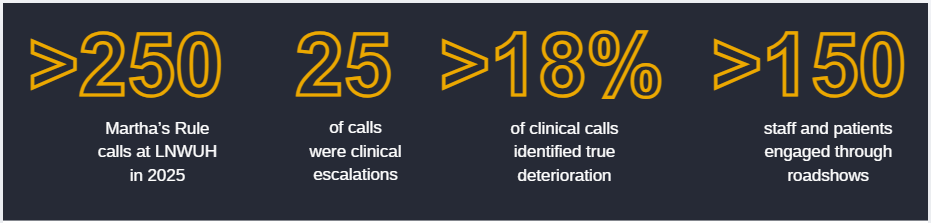
The data from one site, London North West University Healthcare (LNWUH), gives a clear picture of what Martha’s Rule looks like in practice. Over 250 calls in 2025. Around a quarter clinical. Of those, nearly one in five related to true clinical deterioration, triggering interventions that prevented further deterioration. And the demographic profile of callers closely mirrors the trust’s diverse population: Martha’s Rule is being accessed across ethnic backgrounds and deprivation levels.
That equity dimension is important. A safety measure that only reaches the most confident or connected patients is not a safety measure at scale. ICHP’s culture change work, including MOMENTS training to build psychological safety and encourage speaking up, aims to ensure that the pathway would work for everyone.
“Sharing learnings in the wider Acute Provider Group and receiving support from the Imperial College Health Partners PSC community of practice has been valuable for improving, sharing and scaling learnings.”
Isatu Kargbo, Head of Nursing Critical Care Services, London North West University Healthcare
Safer births: the maternity and neonatal programme
Patient safety in maternity services is one of the most scrutinised and most consequential areas of NHS care. The NWL PSC’s maternity and neonatal programme, commissioned by NHS England, spans four workstreams.
The Avoiding Brain Injury in Childbirth (ABC) programme was launched in 2025 and has moved from strength-to-strength. Avoidable brain injury during childbirth has devastating, lifelong consequences for children and families, and carries an enormous financial cost: reducing it to the level achieved by the top 20% of trusts could reduce national litigation costs by between £860million and £1.4billion per year.
ICHP’s approach has been relationship-led and context-specific, beginning by understanding Workstream Perinatal Culture and Leadership (PCLP) Focus existing practice at each trust before building training that genuinely fits the clinical environment. Train the Trainer sessions have now been delivered across three of the four NWL trusts, with the fourth imminent. The impact is already visible: average clinical confidence among participants rose from 3.35 before training to 4.5 afterwards.
“The ABC programme represents a long-awaited national initiative that will address one of the most devastating outcomes in childbirth: when a baby is born in poor condition. I believe this unified approach will have a significant impact, greatly reducing the incidence of intrapartum foetal adverse events.”
Dr Millicent Nwandison, Consultant Obstetrician, Chelsea and Westminster Hospital
| Workstream | Focus |
| Perinatal Culture and Leadership (PCLP) | Building positive safety culture, psychological safety and QI capability across maternity teams using the MOMENTS framework. |
| Avoiding Brain Injury in Childbirth (ABC) | Reducing avoidable brain injury by improving recognition and response to foetal deterioration and managing impacted foetal head at caesarean birth. |
| Deterioration | Supporting prevention, identification, escalation and response to maternal and neonatal deterioration using MEWS and NEWTT2 tools. |
| Optimisation | Enhancing care pathways for preterm infants through the British Association of Perinatal Medicine’s Perinatal Optimisation Pathway and data-driven QI, with a target of reducing pre-term birth rate to below 8%. |
Building capability that spreads
The PSC’s role as a community builder extends beyond NWL. A pan-London QI and Safety training day, co-led by ICHP, brought together over 80 colleagues from across London’s maternity and neonatal services. ICHP led the QI module, which received a strongly positive response, and the day directly led to two NWL Trust Perinatal Maternity Advocates approaching ICHP to support local improvement and cultural safety work using QI methodology.
That is what building communities of practice looks like in practice: not a conference where people listen and leave, but an event that generates new relationships, new requests and new momentum for safety improvement across the system.
In addition, as culture underpins every safety ambition, ICHP has supported building system resilience, facilitating challenging culture conversations to build staff and system awareness of human factors and wellbeing.
The PSC’s role as a community builder extends beyond North West London (NWL). A pan-London Quality Improvement (QI) and Safety training day, co-led by ICHP, brought together over 80 colleagues from across London’s maternity and neonatal services.
ICHP led the QI module, which received a strongly positive response, and the day directly led to two NWL Trust Perinatal Maternity Advocates approaching ICHP to support local improvement and cultural safety work using QI methodology.
That is what building communities of practice looks like in practice: not a conference where people listen and leave, but an event that generates new relationships, new requests and new momentum for safety improvement across the system.
In addition, as culture underpins every safety ambition, ICHP has supported building system resilience, facilitating challenging culture conversations to build staff and system awareness of human factors and wellbeing.
“Reflecting on the past months of work with ICHP, the support has been genuinely impactful for our service and, importantly, has brought a strong sense of doing to what is often a difficult and abstract area of work. Culture is notoriously hard to shift, but this programme moved beyond conversation alone and translated cultural insight into practical action. That has been pivotal for our escalation work, where behaviours, confidence and relationships matter as much as processes and tools.”
Dilan Chauhan, Trust Quality Lead Midwife for Maternal Safety, The Hillingdon Hospitals NHS Foundation Trust.
Safety by design, not by exception
What runs through all of this work – Martha’s Rule, the maternity and neonatal programme, the QI training days, the communities of practice – is a single design principle. Safety should be built in from the start, not added as a layer when something goes wrong. The systems that protect patients should make the safe choice the obvious choice. The culture that enables speaking up should exist before it is needed.