
Clare Thomson, Innovation Lead, shares why our mission on Cardiovascular Disease is expanding in order to see the full picture in heart health
When I think about the work we’ve been doing as part of our Mission to Optimise care for Cardiovascular Disease (CVD) across North West London (NWL), one truth has become clearer with every conversation, every dataset and every encounter with patients and partners: if we want to truly improve heart health, then we can’t focus on the heart alone. The conditions that raise someone’s risk of a heart attack or stroke rarely show up in isolation. They build, interact and compound across the cardiovascular, renal and metabolic systems long before anyone reaches a clinic with visible symptoms.
That’s why our mission is evolving. We are widening our scope from a focus solely on CVD to a broader, more joined-up view of Cardiorenal Metabolic Care (CRM). This isn’t simply about renaming the work or stretching our remit, it’s about matching the reality of what people experience and creating the conditions for meaningful prevention long before a crisis appears.
Seeing the full picture in heart health
The scale of the challenge makes this shift necessary. Across the UK, far too many lives are still lost each day to CRM diseases and risks, and many of these deaths are preventable. In NWL, approximately 580,000 residents are living with CRM conditions and we also know there is a striking gap between how many people are diagnosed with hypertension, high cholesterol or atrial fibrillation, and how many actually have these conditions. The result is thousands of people carrying unrecognised, unmanaged risk. These silent drivers of disease often progress unnoticed, only becoming visible once damage has already begun.
What we also know, with growing clarity, is that these risks are deeply interconnected. People with Chronic Kidney Disease are 6 times more likely to suffer a major CVD event, an most people with late stage CKD die from CVD before reaching kidney failure. . Metabolic conditions sits at the root of so many of these trajectories, shaping how early or how severely people become unwell. A system organised around single conditions can inadvertently push people between services that each address only part of the picture. A system organised around the full CRM spectrum allows us to act earlier, more consistently and with greater impact.
Designing care that matches real lives
By shifting to a CRM mission, we can design pathways that reflect real patient journeys rather than administrative ones. This approach strengthens prevention, supports earlier detection and helps neighbourhood teams, primary care, acute clinicians, community organisations and industry partners to work toward outcomes that make sense across the whole system. It also creates far greater room for innovation. When we are no longer constrained by a narrow outcome domain, we can explore integrated models of care, test new digital detection approaches and build partnerships that address several risks at once rather than tackling them one by one.
One of the approaches is ICHP’s co-delivery of the CLEAR (Clinically-Led workforce and Activity Redesign) programme, to design a holistic CardioRenalMetabolic model of care in primary care, taking learnings from the Harrow Model. It brings together frontline clinical insight and datadriven analysis to reimagine pathways, optimise workforce use, and support earlier identification and better management of people at risk of, or who have CRM conditions. Through CLEAR’s structured methodology and close collaboration with PCNs and the NWL ICB, the programme is developing a scalable, sustainable model for integrated CRM care across North West London. This partnership approach is strengthening local capability and supporting PCNs to adapt the model to place-based needs, while ensuring alignment with NWL ICB CRM strategy.
By building on learning fromthe Harrow CRM clinic model, , we’re able to apply evidence to maximise impact, with insights from this next phase informing decisions on scaling CRM clinics across NWL.
Focusing on early detection and prevention
As the innovation partner for NWL, our work will continue to centre on early identification and prevention, alongside optimisation of care for those already living with risk. These two pillars give us a simple structure, but behind them sits a more ambitious purpose: to identify risk earlier, to intervene before damage is done and to reduce the inequalities that stand in the way of good health for too many people in our communities.
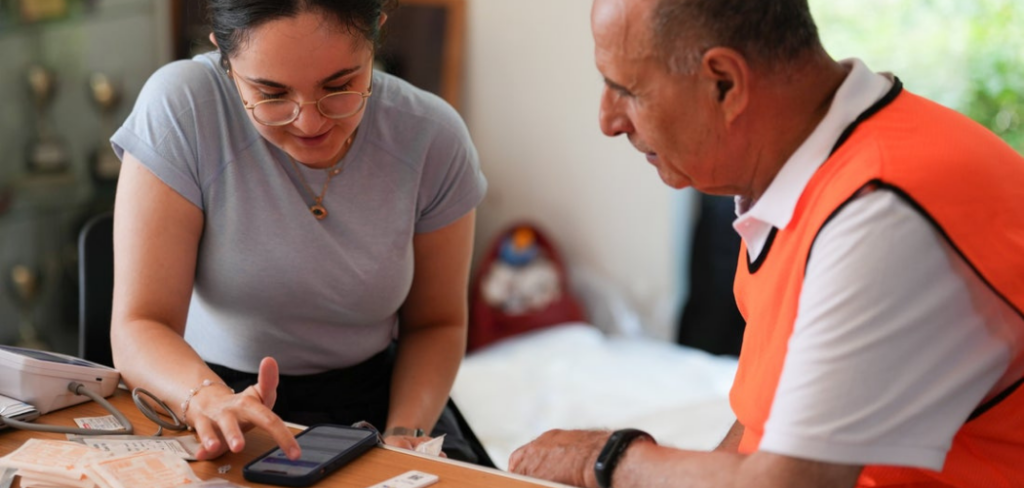
We’re continuing our work with PocDoc, with their easy-to-use rapid testing kits delivering a complete picture of heart health (including cholesterol, heart age and overall CVD risk level) in under 10 minutes, and can be used outside of clinical settings.
The natural next step for better heart health
This shift is not a departure from what we’ve been doing, but the next logical step towards population-level impact. It reflects the evidence, the needs of the population and the direction of the system. Most importantly, it reflects a commitment to protecting more hearts by understanding the whole person. By widening our lens, we give ourselves the best chance of delivering the outcomes we care about most.
Want to learn more about the our mission-led approach to CRM disease?